

Wheelchair Accessible Places in India: Overview and Infrastructure
Finding genuine wheelchair accessible places in india requires moving past generalized travel recommendations and examining specific physical infrastructure. While many tourist sites claim barrier-free access, real-world navigation depends on concrete technical details: ramp gradients, door frame clearance, elevator dimensions, and continuous step-free pathways. This guide breaks down verified accessible destinations, public transit frameworks, accommodation standards, and practical travel strategies across India for wheelchair users, disabled travellers, and their families.
India’s accessibility landscape is defined by the Rights of Persons with Disabilities (RPwD) Act 2016 and the updated Harmonised Guidelines and Standards for Universal Accessibility in India. Under these mandates, national infrastructure standards require specific technical benchmarks:
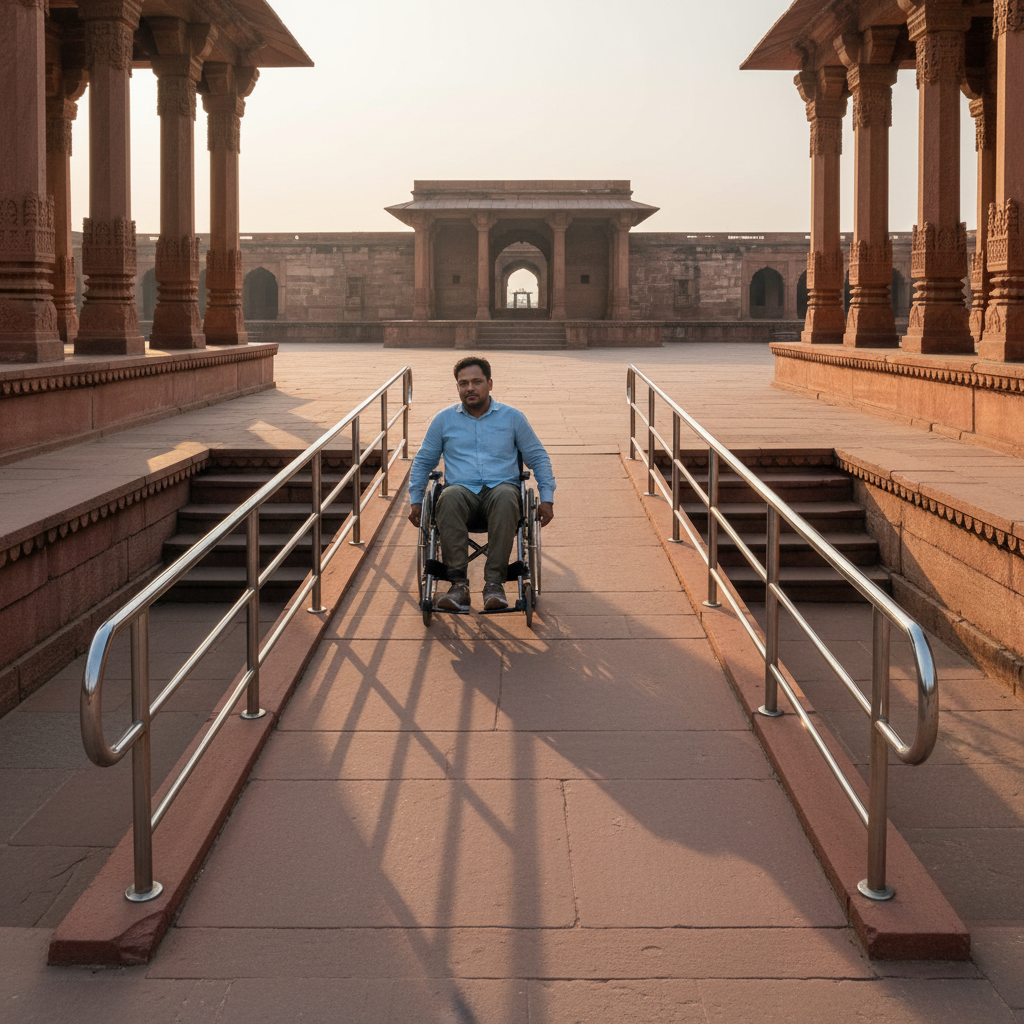
- Ramp Gradients: A maximum slope ratio of 1:12 for short ramps, with a 1:20 gradient preferred for longer runs. Ramps steeper than 1:10 create significant physical strain and safety hazards without powered assistance.
- Doorway Clearances: A minimum clear opening width of 900 mm for all entry doors, elevators, and public facility entrances to accommodate manual and power wheelchairs.
- Accessible Restrooms: Minimum internal dimensions of 1500 mm by 1750 mm to allow a full 180-degree wheelchair turning radius, equipped with outward-opening doors, wall-mounted grab bars beside the WC, and washbasins mounted at a height of 750 mm to 800 mm.
- Handrails: Dual continuous handrails mounted at heights of 760 mm and 900 mm along both sides of ramps and elevated walkways.
Air Travel Infrastructure and DGCA Regulations
Air travel in India provides consistent mobility support governed by the Directorate General of Civil Aviation (DGCA) Civil Aviation Requirement (CAR) Section 3, Series M, Part I. Under these regulations, wheelchair assistance from the airport departure terminal entry gate to the aircraft seat is mandatory and free of charge across all domestic carriers, including IndiGo, Air India, Air India Express, Akasa Air, and SpiceJet.
When booking domestic flights, travellers must specify their assistance requirements using standard International Air Transport Association (IATA) codes at least 48 hours prior to departure:
- WCHR (Ramp Assistance): For passengers who can climb aircraft steps and walk through the cabin, but require assistance navigating long terminal corridors.
- WCHS (Steps Assistance): For passengers who cannot ascend or descend stairs, but can walk short distances inside the aircraft cabin aisle.
- WCHC (Cabin Seat Assistance): For passengers who are completely non-ambulatory and require an aisle transfer chair, trained ground staff, and full support to transfer into their assigned cabin seat.
Major aviation hubs—including Delhi (DEL), Mumbai (BOM), Bengaluru (BLR), and Hyderabad (HYD)—utilize direct aerobridges or specialized high-lift vehicles (ambulifts) for boarding. At tier-2 and tier-3 regional airports lacking aerobridge infrastructure, airlines deploy ramp buses and manual passenger lift chairs.
Under updated aviation guidelines, airlines are authorized to charge assistance fees to non-disabled passengers attempting to reserve airport wheelchairs solely to bypass security lines, protecting operational capacity for travellers with genuine mobility requirements.
Rail Transport Accessibility
Indian Railways classifies major stations under category A-1, A, and B mandates, requiring step-free entry ramps, designated accessible parking bays, tactile paving, low-level drinking water taps, and at least one ground-floor accessible toilet on main platforms.
For long-distance train travel, specific passenger cars designated as SLRD (Second Class Cum Luggage Cum Guard Van & Disabled-Friendly Compartment) are attached to express trains. These coaches feature:
- Wider sliding side entrance doors designed for wheelchair clearance.
- Enlarged compartments containing two dedicated lower berths reserved for disabled passengers and their escorts.
- Widened adjacent toilet cubicles equipped with wall-mounted grab rails and lowered washbasins.
At over 300 major railway junctions—including Thiruvananthapuram Central, Ernakulam Junction, Kozhikode, New Delhi, Mumbai CSMT, and Chennai Central—passengers can utilize Battery-Operated Carts (BOVs) for platform transfers. Passengers can also pre-book the Yatri Mitra Sewa service online or at station help desks to secure dedicated porter assistance for baggage and wheelchair navigation across concourses.
Urban Mass Transit: Metro Systems
Modern urban rail corridors, lead by the Delhi Metro Rail Corporation (DMRC) network, provide end-to-end accessible transit. Station design includes street-level elevators with low-height control panels, Braille buttons, and auditory announcements. Station gates feature dedicated 1200 mm wide Automated Fare Collection (AFC) gates, and train cars offer level platform boarding with designated wheelchair tie-down spaces in end coaches. DMRC maintains a direct customer helpline enabling passengers to request dedicated station staff to accompany them from the entrance gate to their destination train platform.
Top Wheelchair Accessible Places in India: Heritage Monuments
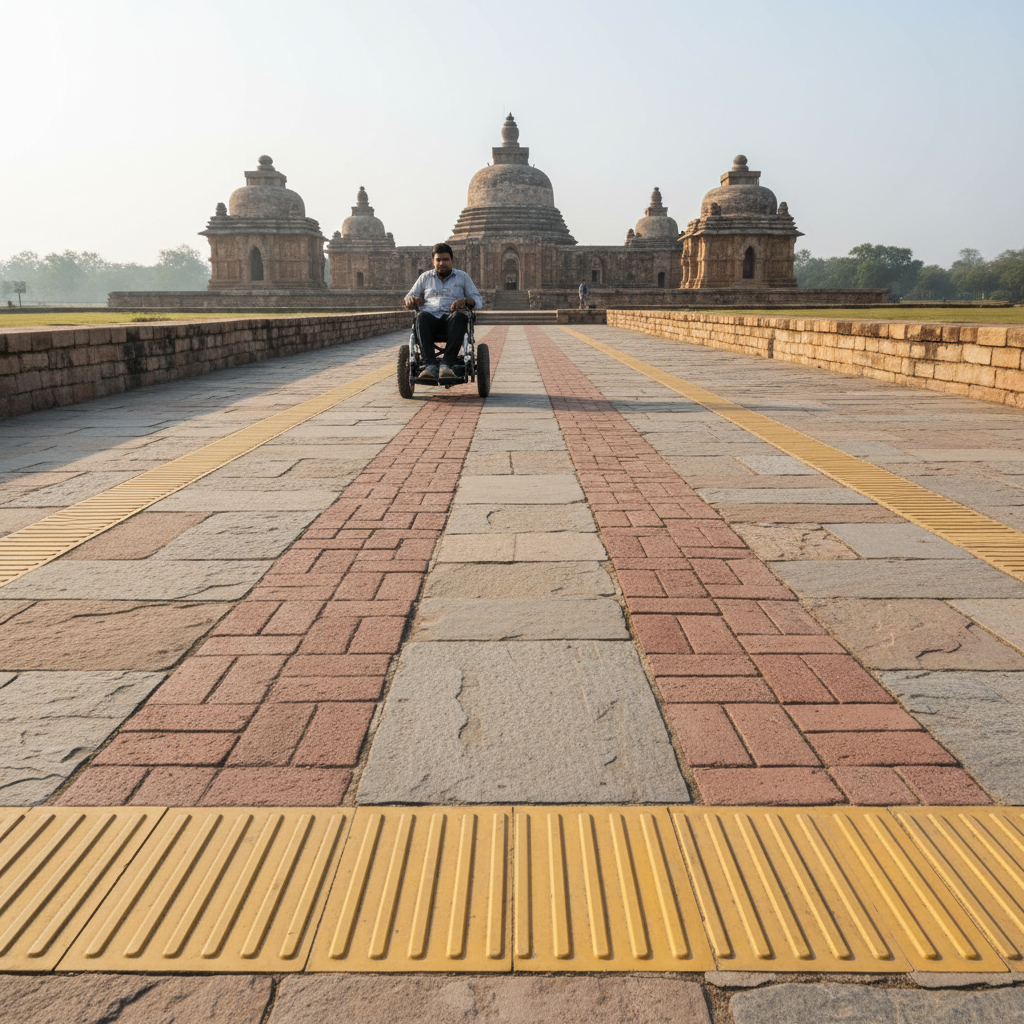
Historical sites pose unique structural challenges due to preservation limits, but several major monuments in North and Central India now feature functional step-free routes developed in consultation with accessibility experts.
1. Qutub Minar Complex (New Delhi)
The Qutub Minar complex serves as a primary model for heritage accessibility in India, featuring concrete ramps built to international 1:12 gradient standards in partnership with access organization Svayam. Smooth stone and paved brick pathways connect the main entrance, the Iron Pillar courtyard, and the surrounding gardens.
- Features: Tactile site maps near the ticket counter, Braille signage, dedicated accessible restrooms, and manual loaner wheelchairs at the entry gate.
- Boundary: Step-free access extends throughout the ground-level ruins and around the base of the minaret. Public entry inside the minaret tower is closed to all visitors.
2. Humayun’s Tomb and Sundar Nursery (New Delhi)
The Charbagh garden pathways surrounding Humayun’s Tomb and the adjacent Sundar Nursery feature flat, wide, well-paved stone paths accessible to both manual and power wheelchairs.
- Features: Continuous level ground access through garden corridors, shade structures, and flat lawn entry points.
- Boundary: Reaching the interior tomb chamber requires climbing a steep, multi-tiered flight of historic stone stairs onto the upper plinth. Due to Archaeological Survey of India (ASI) heritage preservation laws, no lifts or permanent ramps exist to reach this upper platform. Step-free travel is restricted to the ground-level gardens.
3. Red Fort (Old Delhi)
Red Fort features wide, paved ramps extending from the Lahori Gate entrance through the Chhatta Chowk covered market to the Diwan-i-Aam courtyard. Battery-operated golf carts operate across the main lawns for visitors needing transit assistance.
- Boundary: Portions of the pathways near the older quarters consist of uneven cobblestones. These sections cause significant vibration for manual wheelchair users; push assistance or slow movement on power chairs is recommended.
4. Taj Mahal (Agra, Uttar Pradesh)
The Taj Mahal complex provides battery-operated golf carts to transport disabled visitors and elderly travellers from the outer parking areas (East and West gates) directly to the main security entry points. Inside the main gates, flat, wide red-sandstone paved paths run along the central reflection pools and gardens.
- Features: Loaner manual wheelchairs at the customer service office and step-free routes along the primary garden level.
- Boundary: The main marble mausoleum sits elevated on a high decorative plinth reached exclusively by steep marble stairs. There are no lifts or ramp structures leading to the upper marble deck or the interior tomb chamber. Step-free access terminates at the lower garden garden level directly facing the monument.
5. Fatehpur Sikri (Agra District, Uttar Pradesh)
A past recipient of the National Tourism Award for barrier-free heritage, Fatehpur Sikri features dedicated accessible parking spaces, a low-height ticket counter, and custom smooth stone ramps bridging the multi-level stone courtyards leading to Diwan-i-Khas and the lower tiers of Panch Mahal. Accessible toilet facilities and tactile signboards are maintained near the central courtyard.
6. Sanchi Stupa Complex (Raisen District, Madhya Pradesh)
The Sanchi Stupa complex provides a continuous paved, step-free pathway surrounding the perimeter of Great Stupa 1. The site incorporates tactile paving along main walkways for visually impaired visitors, Braille maps, audio guide availability, accessible parking bays, and ground-level accessible restrooms near the primary entrance gate.
7. Ellora Caves (Chhatrapati Sambhajinagar, Maharashtra)
At the Ellora Caves, ground-level access is concentrated at Cave 16 (the Kailasa Temple). A flat, step-free path runs from the vehicle drop-off zone directly into the outer courtyard and ground floor of the monolithic rock temple structure.
- Boundary: Reaching the upper rock-cut cave groups (Buddhist and Jain clusters) requires navigating steep stone stairs carved into the cliffside. Local porters offer carrying chair (*palki*) services for a fee, which requires a physical transfer out of personal wheelchairs.
Wheelchair Accessible Places in India: Coastal and Eco-Tourism Destinations
Select coastal and nature reserves across South India have integrated specialized adaptive infrastructure to make natural terrains navigable for wheelchair users.
Eravikulam National Park (Munnar, Kerala)
Eravikulam National Park operates as Kerala’s first fully barrier-free eco-tourism zone. Visitors transfer from the main entrance into specially adapted, low-step eco-buses equipped with wide entry doors. At the high-altitude Rajamalai drop-off point, golf buggies transport wheelchair users along smooth, gently sloped paved tracks leading directly to the Nilgiri tahr viewing decks, bypassing steep mountain trekking paths. Dedicated accessible restroom facilities are located at both the base visitor center and the upper hill terminal.
Kumarakom and Alappuzha Backwaters (Kerala)
Navigating the Kerala backwaters traditionally presented severe physical barriers due to high boat gunwales and narrow wooden plank gangways. However, targeted operators in Alappuzha and Kumarakom now run custom single-level houseboats designed for mobility access. Key structural modifications include:
- Wide, reinforced metal boarding ramps with side guardrails for level roll-on access from lake docks.
- Interior cabin doorways with clear opening widths exceeding 850 mm.
- Flush, threshold-free floor transitions between the outer viewing deck, living quarters, and bedroom.
- Enlarged ground-floor bathrooms equipped with roll-in shower areas, fold-down shower seats, and wall-anchored grab bars.
Additionally, lakeside resorts such as KTDC Water Scapes in Kumarakom and private venues like Illikkalam Lakeside Cottages offer paved ramp networks connecting accommodation blocks, dining halls, and boat jetties.
Marina Beach Permanent Access Path (Chennai, Tamil Nadu)
In November 2022, the Greater Chennai Corporation (GCC) constructed a permanent 263-metre long, 3-metre wide accessible boardwalk at Marina Beach, extending from the main promenade across the deep sand directly to the high-tide waterline. The structure was built using durable hardwood lined with continuous double-height handrails on both sides.
To enable ocean access, GCC and local advocacy groups (including the Disability Rights Alliance Tamil Nadu) provide floating beach wheelchairs equipped with wide, air-filled balloon tires designed to roll over soft sand and float safely in shallow waters.
Infrastructure Note (2026 Update): Portions of the original wooden ramp structure have undergone maintenance, with GCC introducing High-Density Polyethylene (HDPE) roll-out mat sections across shifting dune areas. Because flexible HDPE mats can deform slightly under the weight of heavy power wheelchairs, self-propelled power chair users should navigate these sections with care or request steadying assistance on uneven sand patches.
Accessible Accommodation Standards: What to Verify Before Booking
The Ministry of Tourism mandates that classified 4-star and 5-star hotels in India maintain at least one fully adapted accessible room. However, room design varies significantly between properties. Travellers should never rely solely on a general “wheelchair accessible” label on online booking portals. Always contact the hotel directly and request written or photographic verification of the following details:
| Hotel Zone | Key Technical Requirement to Confirm | Critical Red Flag to Avoid |
|---|---|---|
| Entrance & Lobby | Step-free ramp or level entry; elevator door clear width minimum 800 mm. | Ramps steeper than 1:8 gradient without handrails; entrance with single 4-inch step without portable ramp. |
| Guest Room Doorways | Clear opening width of at least 800–900 mm for both bedroom and bathroom doors. | Bathroom doors measuring under 700 mm; narrow hallway turns blocking wheelchair entry. |
| Bathroom Layout | Roll-in shower with flat drainage; wall-mounted grab bars next to WC; clearance under washbasin. | Step-in shower tubs; lip thresholds over 20 mm high at bathroom door; loose grab bars suction-mounted to tiles. |
| Bed & Room Clearance | Clear transfer space of at least 900 mm on at least one side of the bed; bed height between 450–500 mm. | Fixed furniture blocking access to side of bed; platform beds raised above 650 mm. |
Ground Realities and Practical Travel Checklist
Despite legislative mandates, urban infrastructure in India exhibits frequent operational gaps. Knowing these friction points allows travellers to prepare contingency plans:
| Infrastructure Element | Intended Access Standard | Frequent Operational Disconnect |
|---|---|---|
| Accessible Restrooms | Unlocked, barrier-free public facility with grab rails and low sinks. | Often kept locked; frequently repurposed as cleaning closets; grab bars mounted too far from the WC pan; doors swinging inward, blocking wheelchair exit. |
| Monument Entry Ramps | Standard 1:12 gradient with double handrails. | Retrofitted ramps with steep 1:4 to 1:6 slopes; lack of side curbs to prevent wheels from slipping off edges. |
| Site Transit Carts | Continuous battery golf cart service for internal travel. | Small vehicle fleets leading to long queues; lack of fold-down ramps on carts, requiring physical transfers. |
| Metro & Station Lifts | Operational elevators connecting street, concourse, and platform levels. | Street-level elevator gates blocked by parked vehicles, vendor stalls, or undergoing unannounced maintenance. |
| Urban Footpaths | Continuous paved sidewalks with low curb cuts. | Footpaths interrupted by open drains, utility poles, construction debris, or abrupt steps without curb ramps. |
Power and Manual Wheelchair Preparation
To prevent mechanical breakdowns during travel, follow these operational steps before setting out:
- Voltage and Power Adapter Setup: India uses Type D and Type M power plugs with a standard supply voltage of 230V at 50Hz. Power wheelchair users should carry a heavy-duty portable voltage stabilizer or surge protector to guard sensitive battery chargers against power fluctuations during hotel recharges.
- Tire and Surface Protection: Paved pathways at historical sites frequently feature rough red sandstone, brick tiles, or cobblestones. Manual wheelchair users should use push-rim gloves to prevent hand abrasions and install high-density foam or air-cell seat cushions (such as Roho or Jay cushions) to absorb ground vibrations. Carry a compact puncture repair kit or spare inner tubes for pneumatic tires.
- Air Transport of Power Batteries: When flying with a power wheelchair, notify the airline at least 72 hours in advance. Provide specifications stating whether the battery is Non-Spillable (Sealed Lead Acid/Gel Cell) or Lithium-Ion. For Lithium-Ion batteries, airline safety rules require the battery Watt-hour (Wh) rating to be clearly labeled on the casing (typically capped at 300Wh for a single battery or 160Wh each for dual batteries). Removable lithium batteries must be detached and carried inside the passenger cabin.
Explicit Pre-Trip Verification Checklist
Because live accessibility conditions change due to local maintenance and weather, verify these specific factors prior to departure:
- Direct Restroom Status: Call destination site administrative offices 24 hours prior to confirm that ground-floor accessible restrooms are unlocked, operational, and not undergoing repairs on your visit date.
- Real-Time Station Elevators: Public transport APIs in India do not currently broadcast live operational updates for individual metro or railway station elevators. Build an extra 20–30 minutes into travel schedules to allow for alternative platform navigation if a street-level lift is temporarily out of service.
- Charging Station Availability: Major public monuments, state parks, and heritage complexes do not provide dedicated public charging stations for power wheelchairs. Charge battery packs fully overnight and carry an extension cord to request emergency top-up charging from standard 5A/15A wall sockets at venue cafes or administrative offices.
Frequently Asked Questions
Are public monuments in India free to visit for disabled travellers?
Yes. The Archaeological Survey of India (ASI) grants free entry to ticketed national monuments and World Heritage Sites for disabled Indian citizens and their accompanying escorts upon presenting a valid government-issued disability card (such as the Unique Disability ID / UDID card) at the entrance counter.
How do I arrange free airport wheelchair assistance for domestic flights?
You can request wheelchair assistance during online flight booking by selecting the appropriate assistance code (WCHR, WCHS, or WCHC). Alternatively, call the airline’s customer service number or update your booking managed portal at least 48 hours before departure. Assistance covers transit from the terminal drop-off lane, through security checks, to the boarding gate and aircraft seat.
Can power wheelchairs be taken on Indian trains?
Power wheelchairs can be transported in the brake van/luggage compartment of Indian Railways trains by booking them as checked parcel luggage. For direct passenger compartment entry, power wheelchairs are generally too wide and heavy to navigate standard coach vestibules. Users travelling in dedicated SLRD accessible coaches typically transfer to manual chairs or use lower berth seating while folding or securing their equipment.
Is the Taj Mahal fully wheelchair accessible?
The Taj Mahal is partially accessible. Battery-operated golf carts take wheelchair users from outer parking areas to the main entrance gates. Smooth sandstone paths allow step-free access throughout the surrounding garden grounds and along the central reflection pools. However, access terminates at the lower garden level; the upper elevated marble deck and the interior tomb chamber are reached exclusively via steep marble stairs without ramp or lift access.
What is the UDID card, and is it recognized nationwide at travel sites?
The Unique Disability ID (UDID) card is a nationally recognized disability identity card issued by the Ministry of Social Justice and Empowerment, Government of India. It serves as official proof of disability across all Indian states and Union Territories for accessing fee concessions, priority queues, accessible transport services, and monument entry passes.


3 thoughts on “Wheelchair Accessible Places in India: Step-Free Travel Guide”