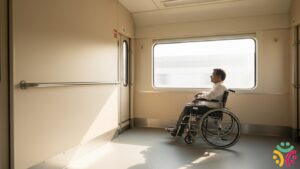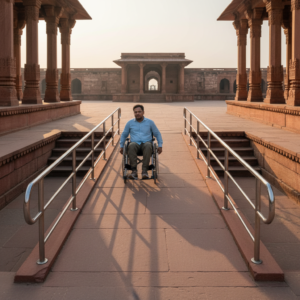

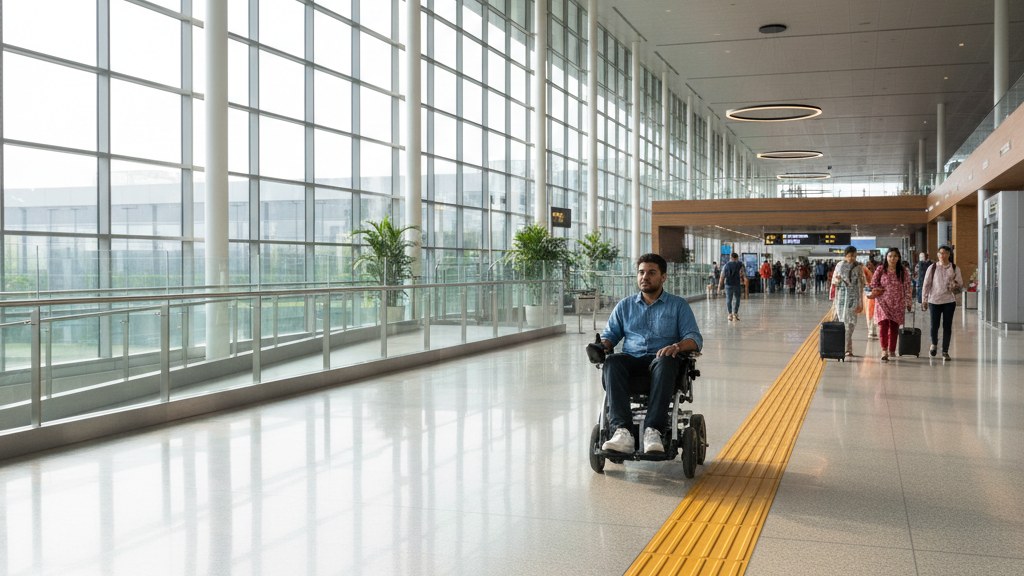
If you are planning a trip and need clear facts, flying with disability in india dgca guidelines set strict legal standards that airlines and airports must follow. Under Indian aviation regulations and federal law, disability assistance at airports is a statutory right, not a favor. Airlines cannot legally charge you for wheelchair assistance, deny you boarding because of a permanent disability, or demand that you remove a prosthetic limb during security checks. This guide details every rule established by the Directorate General of Civil Aviation (DGCA) and the Bureau of Civil Aviation Security (BCAS), explains battery math for powered wheelchairs, and outlines your recourse if an airline fails to meet its obligations.
What are your core legal rights under DGCA regulations?
The primary regulation governing air travel accessibility in India is the DGCA Civil Aviation Requirements (CAR) Section 3, Series M, Part I, titled “Carriage by Air – Persons with Disability and/or Persons with Reduced Mobility”. First issued in 2014 and revised through Revision 6 in 2021, this regulation forms the baseline for passenger rights across all Indian carriers, including IndiGo, Air India, Akasa Air, and SpiceJet.
Following a July 2022 amendment (Paragraph 4.1.35)—enacted after an airline illegally refused boarding to an autistic passenger at Ranchi Airport—the law strictly prohibits airlines from denying boarding based on disability. An airline cannot refuse to carry you based on an assumption about your condition. If an airline crew suspects that a passenger’s health may deteriorate mid-flight, the airline cannot make an arbitrary decision; an airport doctor must physically examine the passenger and issue a written medical opinion. If boarding is still denied, the airline must provide full written reasons to the passenger immediately, within 24 hours.
Under updated regulations in force as of late 2025 and 2026, DGCA clarified rules regarding assistance charges. Wheelchair assistance, ground escort handling, aisle chair transfers, and priority boarding remain 100% free of charge for all genuine disabled passengers and persons with reduced mobility. Airlines are permitted to charge fees for wheelchair bookings only to able-bodied passengers who attempt to misuse the service to skip terminal queues. To prevent disputes at check-in counters, carry your Unique Disability ID (UDID) card or a basic medical certificate when traveling.
These aviation rules are backed by federal law under the Rights of Persons with Disabilities (RPwD) Act, 2016. Sections 3, 40, and 41 mandate non-discrimination, equal right to travel with dignity, and accessible airport infrastructure. Failure to comply carries statutory fines starting at ₹10,000 for a first violation and up to ₹5,00,000 for repeated non-compliance.
Do you need a medical clearance certificate (MEDA)?
Airlines frequently misinterpret rules by demanding “Fit-to-Fly” certificates from disabled travellers. Under DGCA CAR rules, you do not need a medical certificate or MEDA form for stable, permanent physical, sensory, or cognitive disabilities where no active in-flight medical intervention is required. A medical clearance form is legally required only if:
- You have had a recent acute illness, severe infection, or major surgical procedure.
- You have an unstable cardiovascular or respiratory condition that may be affected by cabin pressure.
- You require specialized onboard medical equipment, such as a stretcher or medical oxygen.
When is an escort required?
You have the right to travel independently. An airline cannot force you to travel with an escort unless you are physically unable to assist in your own evacuation during an emergency (such as unfastening a seatbelt or putting on a life vest) or require individual nursing care during the flight. If you do travel with an escort, DGCA CAR Paragraph 4.1.14 requires the airline to make all reasonable efforts to seat your escort directly next to you.
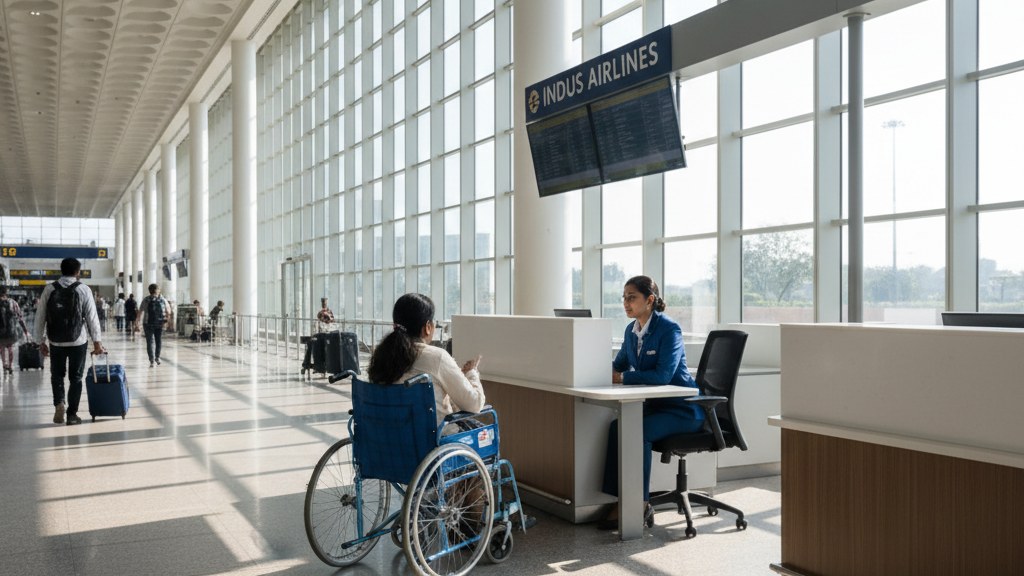
Which assistance code should you select when booking?
When booking a ticket online or through an agent, you must notify the airline at least 48 hours before departure to guarantee equipment and staff availability. Airlines record your specific access requirements using standardized International Air Transport Association (IATA) Special Service Request (SSR) codes.
Selecting the correct code ensures the ground crew brings the right equipment to the gate. If you are also planning step-free connections or accessible road transfers after landing, review our Wheelchair Accessible Places in India: Step-Free Travel Guide.
| SSR Code | Plain Meaning & Purpose | Operational Impact at Airport & Aircraft |
|---|---|---|
| WCHR | Ramp Assistance: Can walk short distances and climb stairs, but needs assistance for long airport corridors. | Wheelchair provided from check-in counter through security to the departure gate or tarmac bus. |
| WCHS | Step Assistance: Can walk short distances inside the cabin, but cannot climb or descend stairs. | Requires a ramp, ambulift, or stair-chair to move between the tarmac and the aircraft door. |
| WCHC | Cabin Seat Assistance: Completely immobile; needs total transfer assistance from terminal to seat. | Requires a narrow aisle-wheelchair transfer directly into the aircraft cabin seat. |
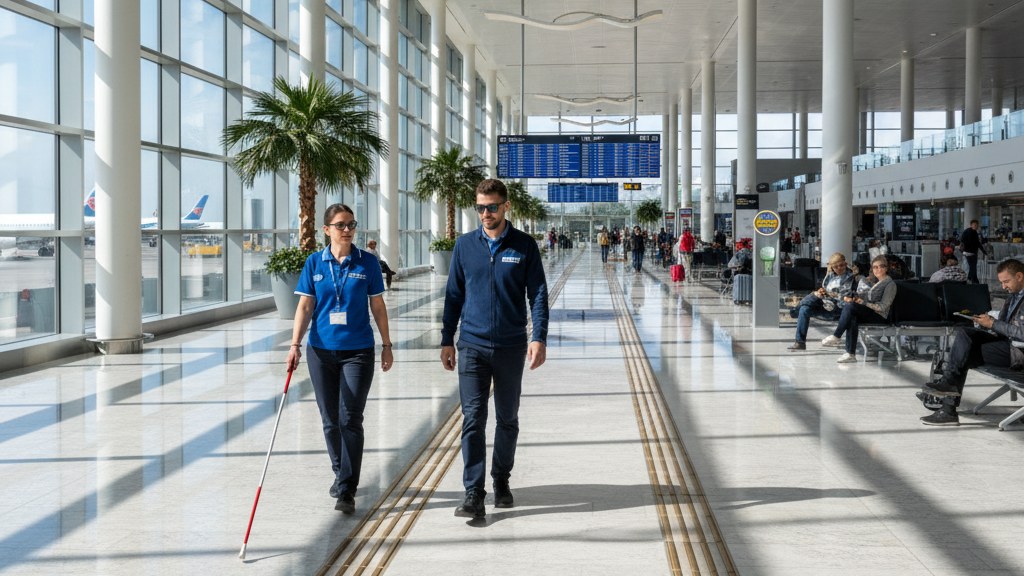
| BLND | Blind or Visually Impaired passenger. | Escort assistance through terminal and security; individual safety briefing in an accessible format on board. |
| DEAF | Deaf or Hard-of-Hearing passenger. | Visual flight updates provided at the gate; safety briefing delivered via written or visual media. |
| DPNA | Intellectual, Developmental, or Neurodivergent assistance (e.g., Autism). | Signals ground and cabin staff to offer clear, calm communication and access to priority security lanes. |
| WCMP | Manual Wheelchair (personal equipment checked in). | Transported free of charge in the cargo hold; tagged at check-in or gate. |
| WCLB | Lithium-battery powered wheelchair. | Triggers battery safety isolation checks and cabin carry-on verification for removable batteries. |
How do you travel with a personal or powered wheelchair?
Your personal mobility equipment—including manual wheelchairs, powerchairs, crutches, walkers, or prosthetics—is carried free of charge over and above your standard checked baggage allowance. Airlines cannot weigh your wheelchair as part of your luggage quota or charge excess baggage fees for it.
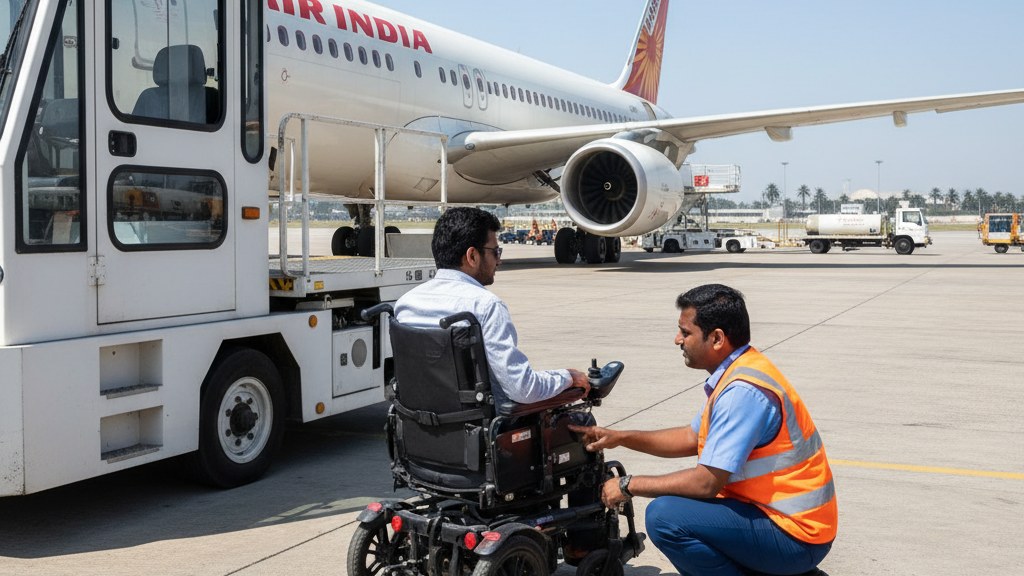
You have the right to use your personal wheelchair inside the airport terminal right up to the boarding gate or aircraft door. At the gate, ground staff will transfer you to an aisle chair or ambulift, tag your wheelchair, and load it into the cargo hold. Upon arrival, the airline must return your personal wheelchair directly at the aircraft door, not at the general baggage carousel, unless you explicitly request otherwise.
Lithium-ion battery regulations for powerchairs
If you fly with a powered wheelchair, Indian safety rules align with IATA dangerous goods regulations and DGCA safety directives. You must calculate your battery’s Watt-hour (Wh) capacity before arriving at the airport using this standard formula:
$$\text{Watt-hours (Wh)} = \text{Voltage (V)} \times \text{Ampere-hours (Ah)}$$
The rules for carrying lithium-ion batteries depend on whether the battery can be removed from the frame:
- Removable Lithium-Ion Batteries: The maximum allowable capacity for a single removable battery is 300 Wh. If your powerchair uses two batteries, each battery must not exceed 160 Wh. Removable lithium batteries must be detached by you or your companion, terminals insulated with electrical tape to prevent short circuits, and carried inside the passenger cabin. They are strictly forbidden in checked cargo holds.
- Non-Removable / Installed Lithium-Ion Batteries: If the battery is permanently built into the wheelchair frame structure, it may remain on the chair in the cargo hold. You must isolate the electrical circuits by switching off the master power switch, disconnecting the wiring harness plug, or removing the control key. No strict Wh ceiling applies if the battery is safely housed inside the frame.
- Spare Lithium Batteries: You may carry a maximum of one spare battery up to 300 Wh, or two spares up to 160 Wh each, inside your cabin hand luggage.
- Dry Cell or Sealed Gel (AGM) Batteries: Non-spillable dry batteries can remain attached to the wheelchair frame in the cargo hold provided the battery terminals are insulated to prevent accidental electrical short circuits.
What are your rights during airport security screening?
Security screening across all commercial Indian airports is conducted by the Central Industrial Security Force (CISF) under rules established by the Bureau of Civil Aviation Security (BCAS). Official BCAS circulars mandate that screening must be conducted with dignity and respect.
Prosthetics and orthotic braces
You are not required to remove prosthetic limbs or orthotic calipers during routine airport security screening. CISF screeners must inspect prosthetics using Door Frame Metal Detectors (DFMD), visual checks, and Explosive Trace Detector (ETD) hand swabs.
A screener may request X-ray inspection of a prosthetic limb only under exceptional circumstances—specifically, if thick foam padding completely obscures the internal mechanical structure, or if the metal detector triggers an unresolved alarm that cannot be cleared by ETD swabs. If an X-ray is required, the screener must record written justification in their official logbook.
External medical devices
Devices such as insulin pumps, continuous glucose monitors (CGMs), cochlear implant processors, pacemakers, spinal cord stimulators, and ostomy bags do not need to be disconnected or removed. Inform the screener before stepping through the detector. Screening for these devices is completed via visual inspection, a quick self-pat-down by you over the device location, followed immediately by an ETD swab test of your hands.
Private screening rooms and wheelchair screening
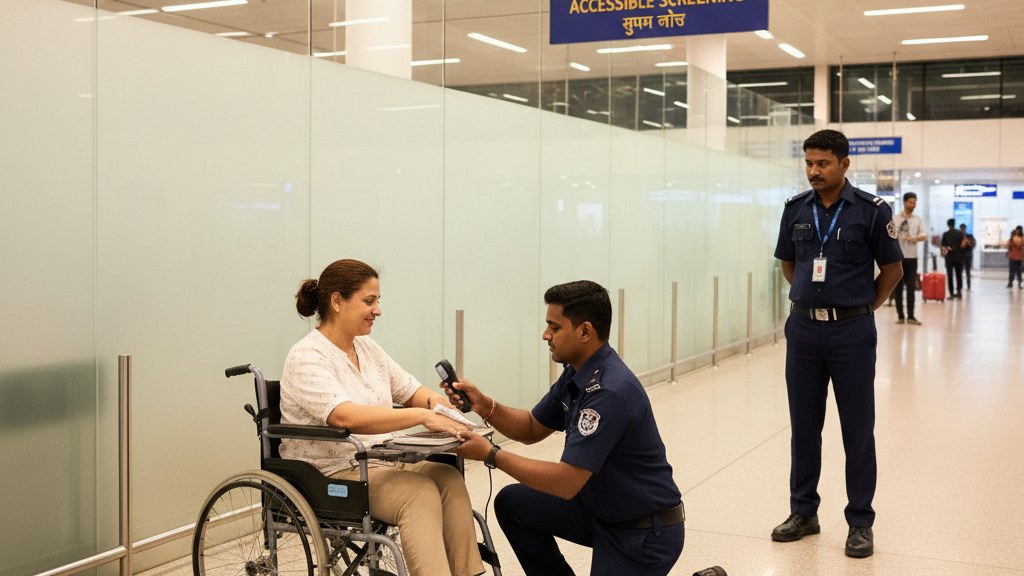
If you use a wheelchair, screeners must complete physical pat-downs and ETD swabs while you remain comfortably seated. You cannot be forced to stand if you are physically unable to do so. Every Indian airport security checkpoint is required to provide an enclosed private screening room. You can demand a private room for any physical pat-down, prosthetic inspection, or personal privacy requirement.
How does boarding work on aerobridges and remote tarmac stands?
Disabled passengers and their accompanying companions are entitled to priority boarding. Ground staff will invite you to board before general passenger boarding begins, giving you time to settle into your seat, store medical equipment, and transfer safely without crowded aisles.
Boarding access depends on whether your flight is assigned an aerobridge (jet bridge) or a remote parking bay on the tarmac:
- Aerobridge Boarding: You roll directly from the terminal gate into the aircraft door across a level bridge. If you require cabin transfer, the narrow aisle wheelchair (`WCOB`) meets you at the aircraft door.
- Remote Tarmac Bays: When aircraft are parked away from the terminal building, boarding requires tarmac transfer. Airports use Ambulifts—specially designed motorized hydraulic scissor-lift vehicles that raise wheelchair users safely from ground level to the aircraft door height.
Under the federal Sugamya Bharat Abhiyan (Accessible India Campaign), the Airports Authority of India (AAI) deployed indigenously manufactured Ambulifts across regional Tier-2 and Tier-3 airports. However, local maintenance downtime remains variable at smaller stations such as Patna, Bagdogra, Dehradun, Gorakhpur, Vijayawada, or Imphal. When traveling through regional airports, always call the airline’s local station manager or airport operations 48 hours prior to departure to verify that the Ambulift is operational on your travel date.
In-flight accessibility features
Under DGCA regulations, commercial aircraft operating in India with 100 or more passenger seats must be equipped with:
- An onboard aisle wheelchair (`WCOB`) stored in the cabin to help you move between your seat and the lavatory during the flight.
- At least one accessible lavatory equipped with grab bars, low-height handles, and accessible door latches.
- Safety briefing cards available in Braille and large print for blind and visually impaired travellers.
In addition, DGCA CAR Paragraph 4.1.16 permits certified guide dogs assisting blind or visually impaired passengers to travel inside the passenger cabin free of charge. The guide dog must be harnessed, vaccinated, and seated at your feet without obstructing aisle walkways.
How accessible are major Indian airports?
Terminal accessibility varies across Indian airports depending on when infrastructure was built or upgraded. The table below details physical access features across major metropolitan hubs and regional airports, current as of August 2026.
| Airport Hub | Drop-Off & Entry Access | Terminal Physical Accessibility | Boarding Equipment Available | Specialized Accessibility Features |
|---|---|---|---|---|
| Delhi (DEL – T3) | Dedicated kerbside PRM drop-off lane; marked help desks. | Continuous tactile paving, low-height helpdesks, wide-stall accessible toilets with drop-down grab bars. | High aerobridge availability; fleet of motorized hydraulic ambulifts for remote stands. | Braille indicators inside elevators; dedicated PRM waiting lounges; audio-tactile maps. |
| Mumbai (BOM – T2) | PRM drop-off at Departure Lane 1 with forecourt assistance staff. | Barrier-free single-level paths, tactile floor indicators, step-free ramps, wide-stall restrooms. | Aerobridge connectivity for most domestic flights; ambulift fleet for tarmac bays. | Dedicated assistance counters at forecourt and arrival levels; priority baggage handling. |
| Bengaluru (BLR – T2) | Marked drop-off zones; electric buggies stationed at entrance. | Tactile pathways, step-free terminal design, accessible seating zones, low counter heights. | High aerobridge ratio; low-floor ramp buses and motorized ambulifts. | Quiet sensory relief rooms designed for neurodivergent and autistic travellers. |
| Hyderabad (HYD) | Ramp access at kerbside drop-off; main assistance desk at entry. | Tactile paving, accessible elevators with voice announcements, wide accessible toilets. | Aerobridges and motorized hydraulic ambulifts deployed for all remote stands. | Dedicated PRM priority lines at CISF security screening lanes. |
| Chennai (MAA) & Kolkata (CCU) | Kerbside ramps at departure gates. | Step-free ramp entry, lifts with Braille buttons and voice cues, accessible restrooms in main halls. | Mix of aerobridges and tarmac stairs; ambulifts available upon 48-hour advance request. | Airline special assistance desks located near main entry gates. |
| Tier-2 / Tier-3 Airports (e.g., Patna, Dehradun, Bagdogra, Gorakhpur) | Basic kerbside entry ramps. | Variable; ramps present at main doors, but internal tactile paving can be inconsistent. | Rarely have aerobridges. Rely on AAI Ambulifts or manual stair-chairs. | Note: Always re-confirm ambulift functional status directly with the airline station manager 48h prior. |
For detailed ground mobility guides across Indian destinations, explore our step-free travel guide for wheelchair accessible places in India.
How do you escalate a complaint if your rights are violated?
If an airline or airport operator refuses mandatory wheelchair service, attempts to charge illegal fees, damages your personal mobility equipment, or denies boarding, follow this four-tier escalation path to seek immediate redress and legal compensation.
Escalation Flowchart:
Level 1: On-Ground Airline Duty Manager & Airport Station Nodal Officer
│ (If unresolved, denied service, or equipment damaged)
▼
Level 2: AirSewa Portal (airsewa.gov.in/ Mobile App)
│ (30-day legally mandated resolution window monitored by DGCA)
▼
Level 3: CPGRAMS Portal (pgportal.gov.in)
│ (Systemic regulatory violations reported to Ministry of Civil Aviation)
▼
Level 4: CCPD Quasi-Judicial Court & E-Daakhil Consumer Court (edaakhil.nic.in)
Step 1: On-ground intervention
Ask immediately for the Airline Duty Manager or the airport’s Nodal Access Officer. Quote DGCA CAR Section 3, Series M, Part I. If equipment is damaged, insist on inspecting it at the baggage arrival belt before leaving the hall, and demand an official Property Irregularity Report (PIR) from the airline ground crew.
Step 2: AirSewa official redressal portal
File an official complaint online at AirSewa (airsewa.gov.in), managed by the Ministry of Civil Aviation. Select the category Disability Assistance or Denied Boarding. Upload your PNR, boarding pass, PIR report, and photo/video evidence. AirSewa routes the complaint directly to the airline’s compliance officer and DGCA monitors, with a legally mandated 30-day resolution timeline.
Step 3: Central Public Grievance Redressal (CPGRAMS)
If the airline fails to resolve the issue satisfactorily within 30 days, lodge a grievance on CPGRAMS (pgportal.gov.in) under the Ministry of Civil Aviation. CPGRAMS tracks regulatory compliance violations by DGCA officials and airport management operators.
Step 4: Quasi-judicial legal action
For statutory rights violations under the RPwD Act 2016, file a petition with the Court of the Chief Commissioner for Persons with Disabilities (CCPD). The CCPD court has the authority to issue legally binding directives and reprimand airlines. To claim financial compensation for damaged powerchairs, medical expenses, or missed travel, submit a claim through the digital consumer court platform E-Daakhil (edaakhil.nic.in).
Frequently Asked Questions
Is wheelchair assistance free at Indian airports?
Yes. DGCA Civil Aviation Requirements and the RPwD Act 2016 mandate that wheelchair assistance, terminal escort handling, aisle chair transfers, and priority boarding are 100% free of charge for all genuine disabled travellers and passengers with reduced mobility. Under revised DGCA guidelines, airlines are permitted to charge fees only to able-bodied passengers who attempt to misuse wheelchair bookings to bypass general terminal queues. Carry your UDID card or medical documents to avoid check-in desk disputes.
Can an airline legally refuse to board me because of my disability?
No. Under DGCA CAR Section 3, Series M, Part I (amended July 2022), disability alone cannot be used as grounds to deny boarding. An airline can refuse boarding only if an airport doctor physically examines you, determines that flying poses a severe health risk, and issues a written medical opinion. If boarding is denied, the airline must provide you with full written reasons immediately within 24 hours.
What happens if an airline damages my personal motorized wheelchair?
Airlines are legally responsible for damage caused to mobility equipment while in their custody. If your powerchair or manual wheelchair arrives damaged, do not leave the arrival hall. Report the damage immediately to the airline baggage counter, demand a Property Irregularity Report (PIR), take detailed photos, and file a claim on AirSewa. Airlines must cover full repair or replacement costs for mobility devices damaged during transit.
Can I carry my lithium-battery powered wheelchair on an Indian flight?
Yes. If your powerchair uses a removable lithium battery, the battery must not exceed 300 Wh (or 160 Wh each for a dual-battery system). You must detach the battery, tape over the electrical terminals to prevent short circuits, and carry it inside the passenger cabin. If the lithium battery is non-removable and built into the frame, the chair travels in the cargo hold with its power isolated.
Do I have to remove my prosthetic limb during CISF security checks?
No. Bureau of Civil Aviation Security (BCAS) rules state that amputees do not have to remove prosthetic limbs or calipers for routine security checks. CISF officers inspect prosthetics using metal detectors, visual checks, and Explosive Trace Detector (ETD) hand swabs. X-ray checks are restricted to rare cases where internal structures are completely obscured. You also have the right to request screening inside a private room.
What assistance code should I select if I am autistic or neurodivergent?
Select the DPNA (Disabled Passenger Needing Assistance) SSR code during booking. This code alerts airport ground crew and cabin flight attendants to provide clear communication, queue support, and access to priority security lanes. At airports like Bengaluru Terminal 2, selecting DPNA also provides access to quiet sensory relief rooms.