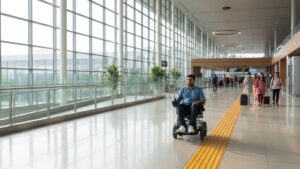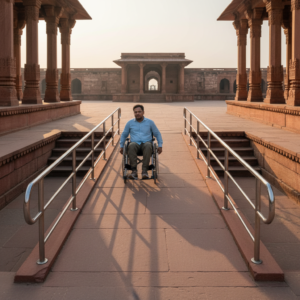

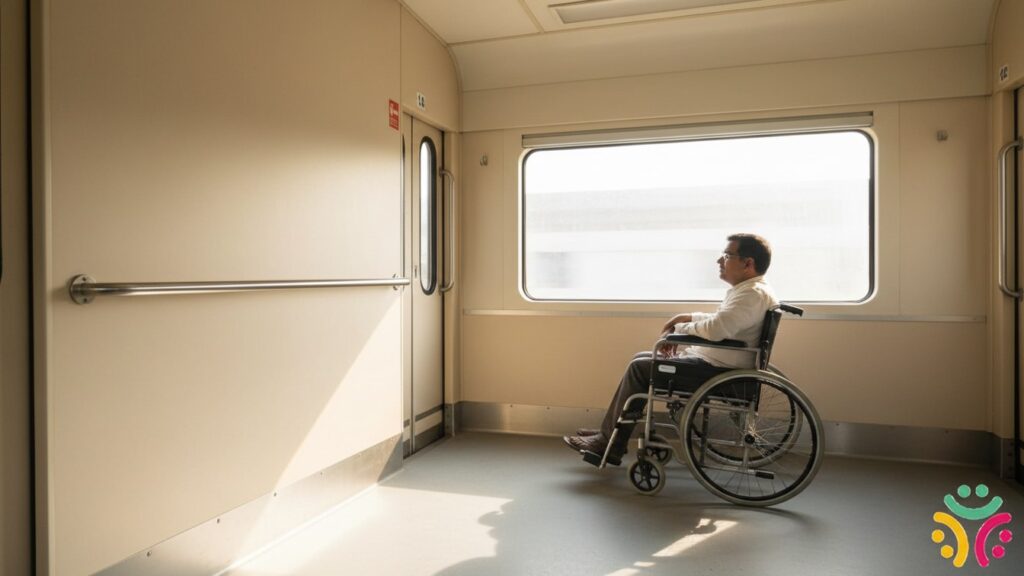
Vande Bharat Express trains offer designated wheelchair spaces, accessible bio-vacuum washrooms, and tactile signage, but physical accessibility is restricted to specific coaches. If you are planning a journey and need to manage wheelchair accessible travel on this service, you must book your seat in the end coaches of the trainset. Intermediate Chair Car coaches and Executive Chair Car coaches do not accommodate wheelchairs due to narrow gangway aisles, and boarding ramps require advance coordination with station staff.
Navigating the booking system, platform gaps, and onboard layouts requires exact preparation. Knowing which coach to select, how to request a boarding ramp, and where facilities are located ensures you can plan a trip without unexpected barriers.
Which coaches have wheelchair space and accessible toilets?
Accessibility features on Vande Bharat Express trainsets are concentrated entirely in the Driving Trailer Coaches (DTC), which are the motor/cab coaches located at the front and rear ends of the trainset. In an 8-coach rake, these facilities are in Coach C1 and Coach C7. In a standard 16-coach rake, they are located in Coach C1 and Coach C14 (or Coach C16/C20 depending on the specific rake configuration).
Standard AC Chair Car (CC) coaches are built with 78 seats in a 3×2 seating configuration. To create accessible space, Indian Railways reconfigured the Driving Trailer Coaches to seat 44 passengers. The space gained by removing 34 fixed seats is dedicated to open floor area for wheelchair parking, a wider central entrance gangway, and an expanded accessible toilet cubicle.
The designated wheelchair area consists of open floor space equipped with heavy-duty stainless steel handrails along the wall. This layout allows a passenger to remain seated in their own wheelchair during the journey or transfer to an adjacent fixed seat. Seats positioned directly beside or behind the wheelchair floor space are earmarked for an accompanying attendant.
Intermediate Chair Car coaches (Coaches C2 through C6 and C8 through C13) and Executive Chair Car (EC) coaches (Coaches E1 and E2) present hard physical barriers. The gangway aisles between seats in standard Chair Car coaches are designed for single-file walking and cannot accommodate manual or motorized wheelchairs. Furthermore, the inter-coach gangway doors connecting coaches cannot be navigated in a wheelchair. If you require a wheelchair or need access to an accessible washroom, you must travel in a designated DTC coach.
How do you board with a ramp at the platform?
Vande Bharat trainsets feature sensor-operated, automatic sliding plug doors that close flush against the coach body during transit. When the train stops at a platform, an integrated retractable step extends outward automatically from beneath the door frame to shorten the stepping distance.
To identify the accessible entrance from the platform, look for the International Symbol of Accessibility (the wheelchair emblem) marked prominently on the exterior wall beside the automatic doors of Coaches C1 and C7/C14.
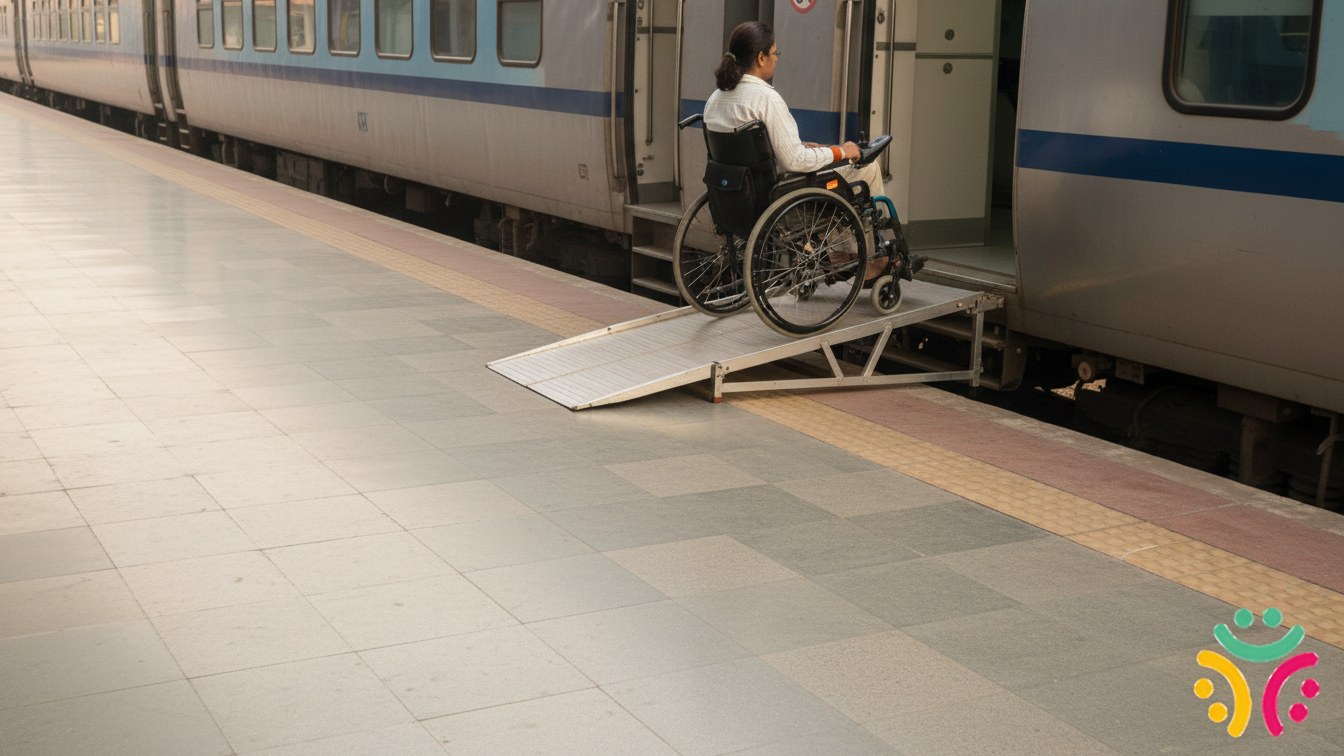
To cross the gap between the platform edge and the train floor, Indian Railways uses portable folding ramps. These lightweight aluminum ramps are stored onboard the train or kept at major railway stations. However, the operational protocol for ramp deployment is manual and on-demand.
Ramps are not automatically placed at coach doors when the train arrives at a station. Station staff must manually position and secure the portable ramp during the train’s dwell time. Because Vande Bharat trains often stop at intermediate stations for only two to three minutes, failing to coordinate ramp deployment in advance can leave passengers stranded on the platform or inside the coach.
Platform heights across the Indian Railways network are non-standardized. Even with the extended retractable step, vertical height differences and horizontal gaps between the platform and the coach floor create tripping risks and wheel entrapment hazards for manual and power wheelchairs if a ramp is not positioned.
What features exist for blind and visually impaired passengers?
Vande Bharat Express coaches incorporate several tactile and auditory navigation aids designed for blind and visually impaired passengers. These features assist with seat location, spatial orientation, and journey updates.
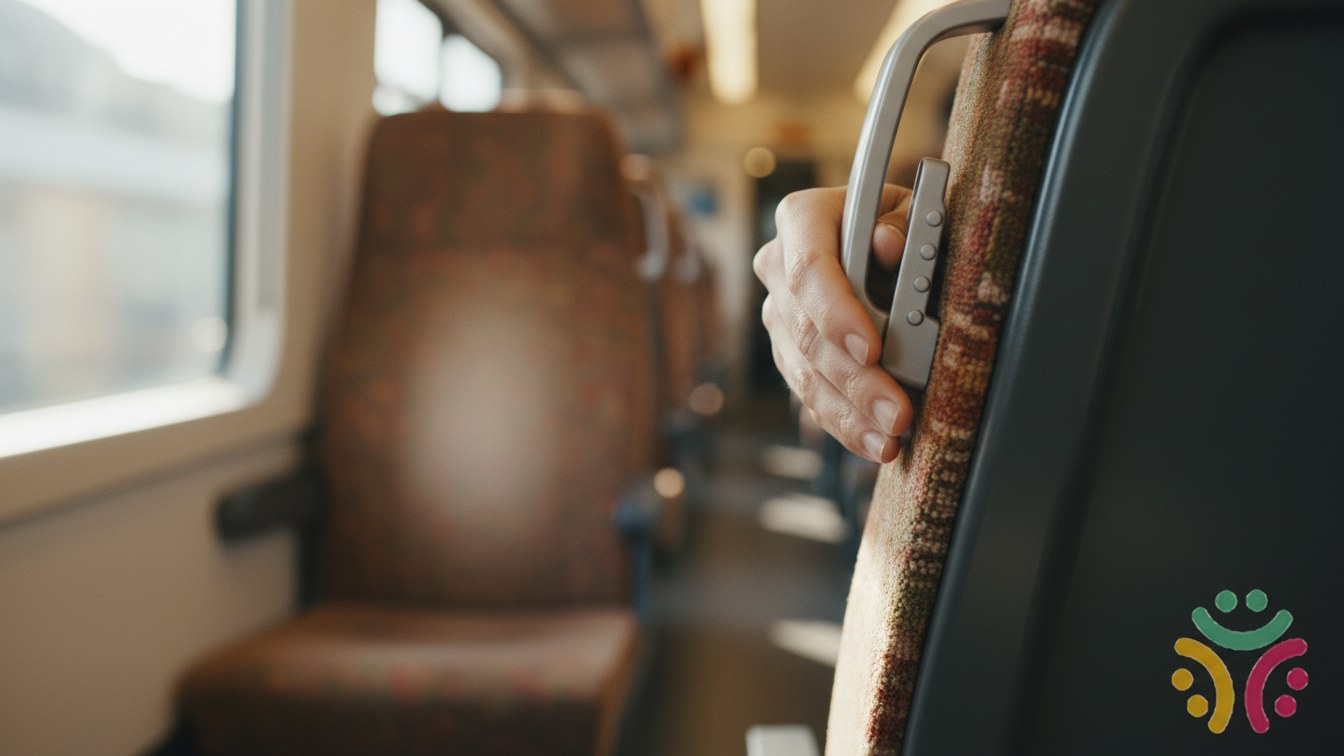
Aisle-side seat handles along the main walkway feature raised embossed Braille and raised tactile numbers. As you move along the central aisle, you can identify your assigned row and seat letter by touching the tags mounted on the top corner of each seat frame. In addition to seat tags, tactile and Braille signage is installed on coach entry door frames, gangway partition walls, washroom door handles, and emergency control panels.
Real-world audits of early Vande Bharat trainsets revealed manufacturing errors on select rakes, where Braille labels were printed as flat ink dots on stickers rather than raised, embossed characters. On some coaches, Braille tags were incorrectly affixed to window frames rather than aisle-side handles. If you encounter unreadable or misplaced Braille tags during your travel, report the coach number to the Onboard Ticket Examiner (TTE) so the issue can be logged for maintenance.
For audio orientation, coaches are equipped with a GPS-based Passenger Information System (PIS). Automated voice announcements broadcast upcoming station stops, arrival delays, emergency notices, and the specific side of the train on which the doors will open at the next platform. Synchronized LED overhead display screens inside the coach present the same station information in English and Hindi.
Coach interiors use anti-glare, diffused LED lighting to prevent harsh glare, while vestibules and lavatories feature high-lux illumination to assist passengers with low vision.
How does the onboard accessible washroom work?
The accessible washroom is located near the entrance of designated Driving Trailer Coaches (C1 and C7/C14). Standard train toilets use narrow, inward-opening hinged doors and tight interior layouts. The accessible bio-vacuum toilet cubicle uses a completely re-engineered design.
The entrance features a wide, automated sliding door operated by a touch-sensitive control panel inside and outside the door frame. Pressing the door button slides the door smoothly along an overhead track, eliminating the clearance obstruction created by swinging doors.
Inside the cubicle, the floor area provides a complete 360-degree turning radius, allowing a standard manual wheelchair to maneuver freely between the entrance, the toilet, and the washbasin. Continuous, non-slip stainless steel grab bars with rounded end bends are mounted along the side and rear walls to assist with body transfers.
Sanitary fixtures inside the washroom are positioned for access from a seated position:
- Bio-Vacuum Toilet Seat: Mounted at a lowered, standardized height with dual grab bars flanking the wall.
- Touchless Controls: The water tap and soap dispenser use automatic motion sensors.
- Flush System: Operates via a soft-touch button or motion sensor linked to a low-water vacuum extraction system.
- Hand Dryer: Mounted at a lower height adjacent to the washbasin.
For safety, an emergency talk-back unit and call buttons are installed inside the toilet cubicle at a reachable height near the floor and beside the toilet seat. Pressing the emergency button alerts the train guard and coach attendant immediately.
How to book a ticket and claim the 25% Divyangjan concession
Indian Railways provides a 25% concession on the base fare for eligible categories of disabled passengers traveling in AC Chair Car on Vande Bharat Express trains. One accompanying escort or attendant traveling on the same PNR receives the identical 25% base fare concession.
To claim this concession online through the IRCTC website or mobile app, you must possess a valid Railway Unique Divyangjan Identity Card issued by Zonal Railways. For complete rules on card issuance and eligibility criteria, refer to our detailed IRCTC Disability Concession ticket booking guide.
Step-by-step online booking procedure
- Log in to your active account on the IRCTC official portal or IRCTC Rail Connect mobile app.
- Enter your origin station, destination station, and journey date in the train search tool.
- Select the “Divyaang Concession” checkbox on the search interface.
- Acknowledge the system disclaimer pop-up confirming that you must carry the original Railway Unique Divyangjan Identity Card during travel for onboard verification.
- Select the specific Vande Bharat Express service from the search results and choose AC Chair Car (CC).
- On the passenger details screen, enter the passenger’s name, age, and gender, then select the matching concession category from the drop-down menu.
- Type the exact Railway Unique ID card number, card issue date, and validity date into the system fields.
- If traveling with an attendant, add the attendant’s details under the designated escort concession field.
- Request seat assignment in Coach **C1** (or C7/C14) to ensure your seat is adjacent to the open wheelchair parking area and accessible washroom.
- Proceed to payment. Your issued e-ticket will display the concessional fare breakdown and coach assignment.
Offline counter booking and station assistance
Concessional tickets can also be purchased at Passenger Reservation System (PRS) counters at railway stations by submitting a self-attested photocopy of your Railway Unique ID Card. If you do not hold a Zonal Railway card, counter staff may issue concessional tickets upon presentation of a Government Unique Disability ID (UDID) card alongside an official Railway Concession Certificate signed by a government hospital doctor.
If you require station assistance to reach the platform, Indian Railways provides free e-wheelchair reservations at major terminal stations (such as New Delhi, Howrah, Mumbai Central, Chennai Central, and Bengaluru City). You can reserve an e-wheelchair through the IRCTC portal under “AT STATIONS” -> “E-Wheelchair”. Upon arrival at the station collection counter, you must present a valid photo ID and pay a refundable ₹500 security deposit, which is returned when the wheelchair is brought back. Battery-Operated Cars (BOC / golf carts) are also available at major A1 category stations under the Sugamya Bharat Abhiyan initiative.
Comparing coach features across the trainset
Accessibility features vary significantly depending on where you sit in the trainset. The table below compares physical layout parameters across the three primary coach configurations used on Vande Bharat Express services.
| Coach Feature | Driving Trailer Coach (C1, C7/C14) | Intermediate Chair Car (C2–C6) | Executive Chair Car (E1–E2) |
|---|---|---|---|
| Wheelchair Floor Space | Available (Dedicated area with handrails) | Not Available | Not Available |
| Accessible Bio-Vacuum Toilet | Available (Wide sliding door, grab bars) | Standard Bio-Toilet Only | Standard Bio-Toilet Only |
| Gangway Aisle Width | Expanded central entry area | Narrow (Standard 3×2 seating layout) | Standard 2×2 aisle (Restricted for wheelchairs) |
| Braille Seat Numbers | Available on aisle seat tags | Available on aisle seat tags | Available on aisle seat tags |
| 25% Divyangjan Concession | Applicable (with valid ID) | Applicable (with valid ID) | Applicable (with valid ID) |
What physical and systemic barriers still exist?
While Vande Bharat trainsets mark an advancement over older conventional ICF and LHB passenger coaches, notable physical and operational gaps remain documented through passenger audits, legal petitions, and NGO evaluations.
The primary restriction is capacity. A 16-coach Vande Bharat train carrying 1,128 passengers provides only one or two dedicated wheelchair parking spots per trainset. If a group of wheelchair users plans to travel together on the same train, the current layout cannot accommodate them in designated spaces.
A second recurring barrier is ramp availability and deployment reliability. Ramps are not integrated into every coach door. If station staff are unaware of a arriving passenger or lack operational training, passengers are frequently lifted over the platform gap by family members or station porters, presenting safety hazards.
On early-generation rakes, floor tie-down straps and wheel clamps were omitted in the wheelchair parking area. While side handrails exist, the lack of floor restraints means unbraked wheelchairs can slide during sudden braking or rapid acceleration. Newer manufacturing batches are addressing this deficiency.
In the IRCTC online booking software, system quotas historically treated Divyangjan seats under general reservation algorithms without hard-locking Coach C1 floor space exclusively to wheelchair users. As a result, non-disabled passengers sometimes book adjacent seats while wheelchair users face allocation errors when trying to select designated spaces.
Certain technical specifications remain unverified in published railway circulars. While official communications cite “wider doors,” the exact door clear-opening dimensions in millimeters have not been published. Additionally, whether 100% of operational Vande Bharat trainsets carry onboard folding ramps versus relying on station-stored ramps varies across railway zones. Direct auto-validation of national UDID cards on IRCTC without a Zonal Railway card also remains in gradual rollout.
Frequently asked questions
Can a wheelchair user travel in Executive Class on Vande Bharat Express?
Executive Class coaches (E1 and E2) do not contain wheelchair parking spaces or accessible washrooms. The 2×2 seat gangways do not accommodate manual or power wheelchairs. To use onboard wheelchair space and accessible toilets, you must book your ticket in Coach C1 or C7/C14 in standard AC Chair Car (CC).
Are wheelchairs provided onboard the train during the journey?
No. Indian Railways does not provide onboard transfer wheelchairs for moving through the coach during transit. Passengers must travel in their own manual or motorized wheelchair or transfer to a fixed seat. Station e-wheelchairs are for platform transfer only and cannot be taken onboard the train for the journey.
How far in advance should I request a boarding ramp at the station?
Report to the Divyangjan assistance booth or contact the Station Master’s office at least 45 to 60 minutes before scheduled departure. Informing station staff early allows them to locate the portable ramp and position staff at your specific coach door prior to train arrival.
Does an accompanying attendant get a fare concession on Vande Bharat Express?
Yes. One accompanying escort traveling on the same PNR with a valid Railway Unique Divyangjan Identity Card holder receives the same 25% concession on the base fare in AC Chair Car.
What happens if a station does not have a portable ramp available?
If a portable ramp is unavailable or staff fail to deploy it, platform height mismatches require manual assistance across the train step. Inform the Onboard Ticket Examiner (TTE) as soon as possible after boarding so they can alert destination station staff to prepare assistance before you arrive.